Lee Miller‘s revival has been a long time coming, but thanks to the herculean efforts of her son Antony Penrose, grand-daughter Ami Bouhassane, and the recent Kate Winslet film Lee, her heroic legacy now lives on as a pivotal 20th-century artist and photographer.
The model, muse, Surrealist and photojournalist is perhaps best known for her iconic WW2 photographs as she accompanied US troops into Europe, capturing the brutal realities of the battlefield and the liberation of the concentration camps, which as a woman was unheard of.
But like so many war stories, as WW2 ended and the world moved on, her photographs were largely forgotten and Lee Miller’s work faded into obscurity, while she struggled with PTSD, depression and alcoholism.
That’s all changed, thanks to Ami, Antony and Kate Winslet’s recent extraordinary film Lee which has made great inroads into introducing Lee Miller to the general public, rather than just the literati, and doors have kept opening.
‘fighting for Lee’s work to be recognised has been such a huge part of our lives’
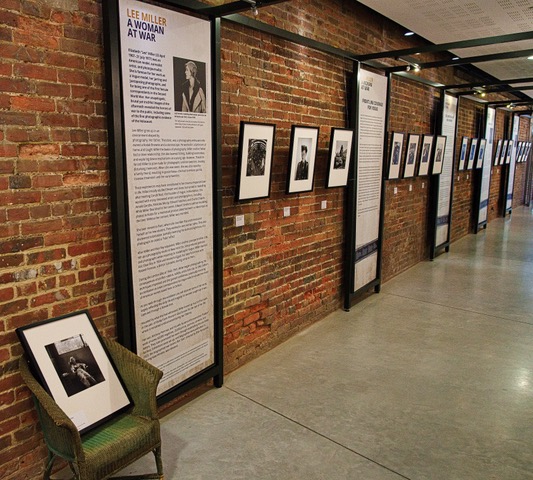
Following a recent retrospective at Tate Britain, Soldiers Of Oxfordshire Museum in Woodstock has followed suit with a new exhibition Lee Miller: A Woman At War which runs until September 13, concentrating purely on her WW2 photography, which includes a stint in Oxford’s Churchill Hospital, more of which later.
And with Ami giving a talk at SOFO on her famous grand-mother on September 3, we chatted to her about what the exhibition means to Lee’s family and her heritage.

“We’ve been trying to get Lee Miller exhibitions off the ground for 28 years,” Ami explains. “Me and my dad would go and pitch to galleries and museums but no one was interested. There were exceptions but it was a hard graft. It’s only in the past 12 years that things have changed, but in the 70s no one wanted to know. It was if they didn’t want to acknowledge that women could paint and take photographs, which is so crazy.”
“So it’s difficult to separate yourself from it, because fighting for Lee’s work to be recognised has been such a huge part of our lives, and even though she died when I was little it still feels really personal,” Ami says.
“But I feel incredibly proud and very lucky to be able to work with Lee’s story and photos, and being related to her still feels kind of unreal so I’m very proud and grateful to be her grand-daughter because she was such an inspirational person.”
the iconic photograph of her bathing in Hitler’s bathtub in Munich on the same day he died was heavy in symbolism, when she wrote ‘I washed off the dirt of Dachau in his tub’
So how did the SOFO exhibition come about? “We were immediately interested in SOFO’s vision of focusing purely on Lee’s war photography rather than a straight retrospective.
“But another reason we were so keen to go ahead with Lee Miller: A Woman At War is because of The Churchill Hospital’s relevance to her work. It was Lee’s first war-time assignment as a photojournalist for Vogue portraying the US nurses working there. After that Vogue had confidence in her and gave her more WW2 assignments.
“It wasn’t her first war photography assignment – she’d photographed The Blitz and the women manning London’s anti-aircraft searchlight batteries, but at Oxford she got a taste of what was to come, by raising awareness of the US nurses experiences. She had also worked as a photographer in Paris taking pictures of surgeons at work, so that helped her in the casualty clearing field hospitals in Normandy.
“So we are really excited about the Woodstock exhibition because we always welcome different ways of portraying Lee’s work,” Ami explains.
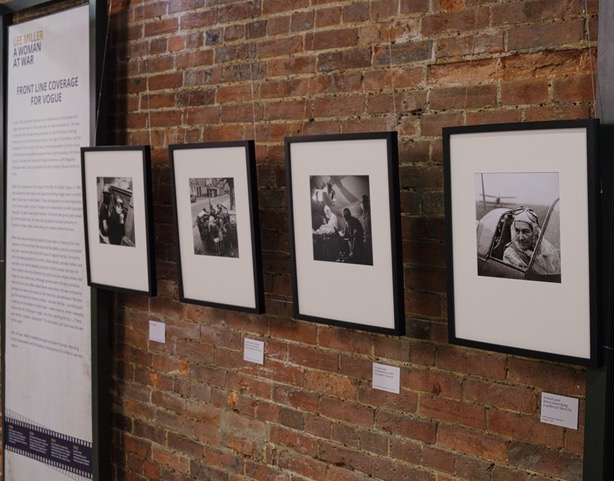
After Oxford, Lee went on to become one of the few female photojournalists on the front line covering the Normandy invasion and the liberation of Paris. Her work in the newly-liberated concentration camps of Buchenwald and Dachau was sent to Vogue in 1945, accompanied by the caption ‘I IMPLORE YOU TO BELIEVE THIS IS TRUE, and the iconic photograph of her bathing in Hitler’s bathtub in Munich on the same day he died was heavy in symbolism when she wrote ‘I washed off the dirt of Dachau in his tub’.
But such discoveries and experiences paid a heavy toll on Lee when she returned home to Farleys House, in East Sussex, where the archive of her 60,000+ negatives and documents are now stored, discovered in her attic by her son, Antony, after her death.
‘The general consensus then was to put up, shut up or have a whisky’
“The general consensus then was to put up, shut up or have a whisky,” Ami explains. “Lee was dealing with so much trauma, but back then PTSD was shameful, and as a woman, who wasn’t even supposed to have covered combat, and was seen as the weaker sex, if she’d admitted her trauma she felt she would be doing a huge disservice to a generation of women who wanted to work in her field. So she drank and coped with it alone.
“And that dominated my dad’s childhood. By the time he reached teenage years he had had enough and left. Lee then put all her pictures in the attic, went off to Cordon Bleu cookery school and became a famous celebrity chef.
“She must have realised that continuing as a photo journalist was triggering and putting a broad stroke through it all by putting her stuff in the attic. Becoming a chef meant she could still be vibrant and creative. She didn’t want to fade into obscurity, and said cooking was like therapy,” Ami adds.
Even so, Lee’s relationship with her husband Roland was difficult, and with her son Antony almost irredeemable. “But then my dad met my mum and she was the one who built bridges between them. So while they never had a mother and son relationship they were friends when Lee died.
When Lee’s archives were eventually discovered Ami adds: “My father said that they were like two battle scarred warriors who should have been on the same side. Even her husband Roland was in tears when he heard what Lee had witnessed because she never talked about it.”
‘My father said that they were like two battle scarred warriors who should have been on the same side’
The 2023 film Lee changed all that. Eight years in the making, Ami says they often despaired it would never get off the ground, even though it eventually grossed approximately $24.6 million worldwide.
“Until Kate (Winslet) came on board, Lee’s story had been optioned over and over again. But Kate came to Farleys and really saw the merits of the house and archives. Her passion helped it kick off. She was the driving force behind the film and even paid for some of the crew’s wages herself. But it was worth the wait,” Ami says.
“And Kate really helped with that – seeing it from an outsider’s and a woman’s point of view – now that we know more about mental health. It’s absolutely crazy that after the war everyone went home and just got on with it. But they were all touched by trauma – they just didn’t talk about it.”
So how does Ami feel about Lee now? “I still get a real buzz when people say ‘Oh I know who Lee Miller is. I saw her exhibition at The Tate or The Imperial War Museum or on film. Lee Miller of course!'”
“And Lee could have made a bonfire and burnt all her work, but on some level she knew it was important to preserve what she had seen. Mum and dad have no idea how important their work has been in preserving her legacy.
“It feels wonderful, but it was a hard won battle.”
Lee Miller: A Woman at War runs at Soldiers of Oxfordshire Museum, Woodstock until September 13. Book at https://www.sofo.org.uk/leemiller/
Lee Miller: A Woman at War – An evening with Ami Bouhassane, Thursday September 3 at 3pm. Book here https://www.sofo.org.uk/product/ami-bouhassane-on-lee-miller/